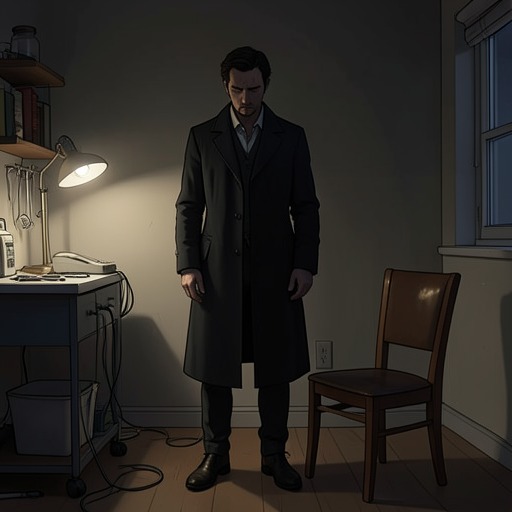
Li Yan
The Killing RoomLi Yan, a deputy section chief in the Shanghai police, leads the investigation into a group of murdered women whose identities and deaths are initially difficult to establish. His authority is tested by a faltering inquiry and conflict within his department, while the investigation demands that he hold several possibilities open at once. He emerges not as an infallible solver but as a working investigator whose judgments can be challenged, corrected, and sharpened by evidence and collaboration.
Position and Investigative Method
Li Yan is asked to take charge of the investigation, then assumes command of a roomful of officers by easing its tension before setting a practical first task. He proposes checking missing-person files for women between fifteen and forty, reasoning that the unidentified victims may already have been reported missing. The proposal turns an immense, disturbing case into a specific search procedure, while keeping identification—not speculation about the killer—as the immediate priority.
The condition of the remains makes that work difficult. Dr Lan explains that decomposition has made visual matching nearly impossible and that the body parts must be compared through bone ends and DNA samples sent to a laboratory. Li listens as the team assesses what can be inferred from the evidence, rather than treating an uncertain identification as settled. The remains had been frozen before burial, Dr Lan concludes from signs of freezer burn; their partial thawing and shallow burial support an estimate that they were buried four or five days earlier. The estimate helps establish a sequence of handling without, by itself, identifying who carried it out.
Li also insists on comparing the Shanghai case with a murder in Beijing without assuming that similar crimes must have the same perpetrator or method. He notes that the Beijing body has been kept frozen and arranges for it to be thawed and re-examined, anticipating that the Shanghai findings will allow a more definitive comparison. When Detective Dai points out that the number of victims makes a lone killer less plausible, Li accepts the objection but returns the discussion to identifying the dead. His approach is provisional: a theory is useful only while it remains answerable to the evidence, and an arresting possibility must not distract from the next verifiable task.
Authority, Conflict, and Responsibility
Li’s authority is tested as the investigation falters. At a review after five days, a senior prosecutor reduces the team’s progress to four identifications, a tentative description of a man with a harelip, and a medical student not yet connected to the crime. The blunt accounting exposes the distance between the scale of the inquiry and what it has established. Later, a crowded, smoke-filled detectives’ meeting makes the strain visible: Section Chief Huang presides, while Li, seated below him in the department’s hierarchy, must keep directing work under the weight of a case that is not advancing fast enough.
The strain becomes an open contest when Huang asserts control of the department and rebukes Li for acting beyond his authority. Li nevertheless presses the investigation toward the Shanghai World Clinic. He tells Huang that he will take detectives and forensic officers there with a warrant if possible, and without one if necessary; obstructing the search, he warns, will bring charges and a corruption investigation. The threat marks a shift from managing an inconclusive inquiry to confronting the institutional resistance that may be sheltering it. Li’s resolve does not erase his dependence on formal process, but he makes clear that rank will not be allowed to stop the investigation.
His public responsibilities run alongside a more vulnerable attachment to Margaret Campbell. When she appears tired and exposed, Li draws her into an embrace, and the moment reveals affection that neither professional collaboration nor their strained circumstances have displaced. He later asks her to collect Xinxin and bring her back to Shanghai, entrusting her with the child’s care while the investigation continues. When Xinxin is found bound and blindfolded at the detention site, Li drops to his knees beside her; the urgency of the search has become inseparable from his responsibility as her uncle. After the immediate danger, he turns back toward Cui Feng with official papers in hand, poised between the personal crisis and the unfinished work of justice.
Pressure, Sympathy, and the Limits of Certainty
The investigation’s pressure reaches Li not only as a professional failure but as private despondency. Alone in the dark, with traffic audible from the elevated ring road, he thinks of Huang’s terminally ill wife and wonders whether death is worse than the troubles of the living. He recognizes that other people may have problems as serious as his own, yet that knowledge does not lessen what he feels. His reflection is not a resolution so much as an admission that the burdens of others cannot be converted into comfort by comparison.
The identification of Wu Liyao’s body tests Li’s understanding of grief from another direction. Sun Jie remains composed, saying that knowing his wife is at peace allows him to be at peace as well. Li envies the simplicity of this faith, while doubting that such reassurance can make death easy to accept. The encounter complicates the investigator’s usual task of establishing facts: a body can be identified, but the meaning of loss belongs to those who remain, and Li cannot simply reason his way into sharing Sun Jie’s consolation.
That same need to distinguish what is known from what is assumed shapes Li’s response to Margaret Campbell’s emerging insight. Faced with the remains, she realizes that an excess of information has obscured an obvious clue and admits that she had been looking in the wrong place. Li does not pretend to have reached the answer before her; he asks what, in the evidence before them, she has now recognized. The exchange presents investigation as collaborative correction: Margaret identifies the danger of being distracted by detail, while Li makes room for the inference to be stated and tested rather than substituting his own certainty.
Reassessment and the Case’s Wider Pattern
Li Yan’s caution about connecting the Shanghai and Beijing crimes rests on a concrete difference, not mere reluctance to commit to a theory. When Margaret Campbell re-examines the Beijing victim, she finds that the woman was alive when the procedure began, as were the Shanghai victims, but the two cases diverge in crucial particulars: the Beijing body retains the lungs, one kidney, and eyes, and its bones were sawn rather than chopped. The shared circumstance raises the possibility of a connection; the distinct surgical traces warn against treating resemblance as identity. Li’s decision to wait for a fuller comparison makes uncertainty part of the investigation rather than a gap to conceal.
The earlier Beijing case has already shown how much can turn on what appears to be persuasive physical evidence. At trial, a defence lawyer acknowledges that the shoe prints correspond to photographs of footprints from the murder scene, a comparison that seems to point toward the same pair of shoes. Afterward, Li walks away struggling to contain his anger, so absorbed that he fails to notice the street around him until a police jeep pulls alongside. The episode gives his later insistence on an open mind a personal cost: evidence may look decisive and still fail to deliver the certainty a case needs.
That discipline does not prevent him from recognizing when the accumulating facts demand a larger conclusion. Once Xinxin’s abduction enters the investigation, Li states that it is inextricably linked to the murders of eighteen women in Shanghai and one in Beijing. The claim gathers the separate strands into a single urgent pattern, turning a case about identifying victims into a search for the people and institutions behind connected crimes. The abduction is not a diversion from his professional work; it makes the stakes intimate while reinforcing the need to pursue the wider investigation.
Li’s trajectory is therefore defined by command under pressure and a willingness to revise. He can steady a tense team, specify the next practical step, and confront obstruction, but he also depends on other people’s observations: Detective Dai challenges the lone-killer theory, and Margaret’s reassessment forces the Beijing comparison into sharper focus. His authority is most consequential when it does not become a claim to be right in advance. At the end, with Xinxin recovered and the immediate danger past, he takes out official papers in front of Cui Feng. The gesture returns him from personal relief to the unfinished demand for accountability.